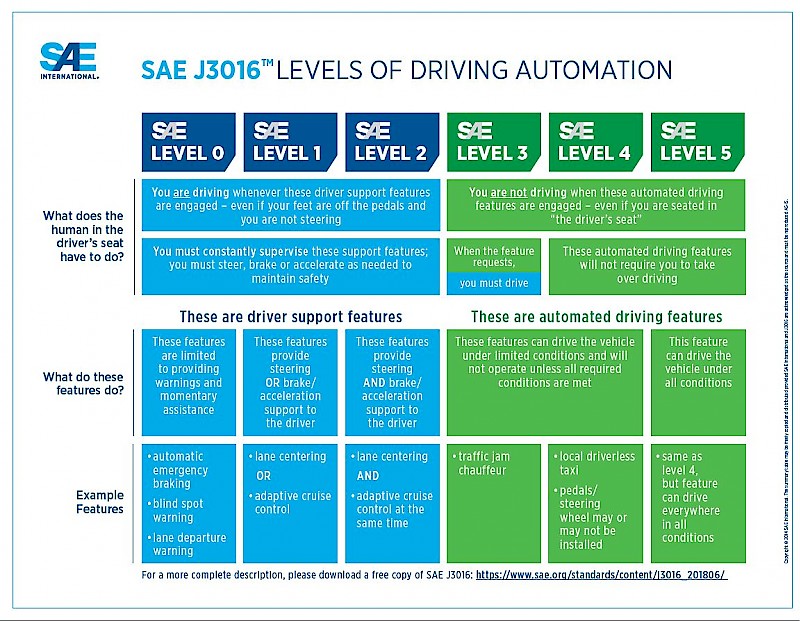
It is a great feature, but, ADAS is by definition not self-driving, no matter how capable it is at manipulating the controls. The lowest level of self driving is level 3, where the human is responsible for supervision less than 100% of the time but greater than 0% of the time. Tesla FSD is level 2 and requires the human driver to supervise operations of the ADAS system 100% of the time.
While FSD's manipulation of controls is impressive -- it is missing a very critical component that is required for self driving: the ability to guarantee whether or not it can make a safe decision. Tesla's FSD still offloads this task to the human driver. Once they can do this more than zero percent of the time, they will have achieved level 3.
It isn't useless. Like cruise control, you don't need full automation to make driving more comfortable. Hands-off level 2 systems are great for long distance travel. I turn them off when I'm navigating situations that require high levels of decision making, however, e.g. driving through a crowded parking garage.
I suppose that comfort is an individual thing - having to sit in place, staring ahead, watching the road, with nothing to do, sounds to me like a kind of torture. I rarely use cruise control; operating the vehicle is what keeps me engaged enough in the drive that my mind doesn't wander. But cruise control is obviously popular, so there are clearly many people who experience driving differently.
You're talking about contracts of adhesion and they are overwhelmingly common for B2C agreements. Most red-lining of contracts only happens in high-value B2B transactions where the sums of money involved are enough that it makes sense to bring lawyers into the loop.
Good, it shouldn't be two clicks for elderly people to install trojans on their phone that then drain their bank account. There should be some explicit confirmation that the user knows what they are doing and they are not being scammed. It is long overdue.
> Good, it shouldn't be two clicks for elderly people to install trojans on their phone that then drain their bank account.
And what makes you think that most scams involve fancy zero days/CVEs/hijacking the OS, and not simple social engineering?
You do not require a malicious apk to receive 2FA codes, or for the gullible user to read them aloud to the scammer. All phones come with an SMS and phone app.
You do not require a malicious apk to send transactions in banking apps (eg tricking people selling their product to send the money.)
You do not require a malicious apk to engage in a pig butchering scam, or to buy gift cards.
> There should be some explicit confirmation that the user knows what they are doing and they are not being scammed. It is long overdue.
I agree. Social engineering counters should have awareness raised by the governments. But blocking 3rd party apps for this is like using a cannon to shoot a mosquito. I'm not sure it makes the slightest of sense.
> We can and should address more than one problem at a time.
Very much agree. Here in India, one of the big telecos has now rolled out a system where if you're on a call with an unknown number, OTPs are not sent to the phone till the call ends. IMO systems like this (or ironically - using OEM installed on device AI as a MITM to stop a call when an OTP is heard) are very good ideas.
> Malicious APKs are a real problem that exists. I work tangentially in this space.
Not doubting it for a moment. I've myself installed an app (that in my defense I pretty much suspected to be malware) that was malware. Even a few weeks ago I helped someone remove a hidden app that was draining their battery like anything (idk doing what, crypto mining or something I guess?). Ofc this app had accessibility permissions and would close settings if you tried to uninstall it.
On the flip side, I've also been stopped by my own phone to give accessibility permissions... to TapTap (a FOSS app by legendary developer quinny98) [1].
I should probably add - here in India, UPI scams use(d?) to be very common, let alone "giving someone your OTP" scams. I personally know someone very close who's lost a good bit of money, purely via someone social engineering them to hand over OTPs.
Even today, scamsters call and threaten a "digital arrest" (whatever the fuck that is) to unsuspecting victims. Presumably many hand over their money.
I have absolutely nothing against technical solutions. But IMO social education to never install apps from outside the play store, combined with "Digital Arrest does not exist" ads that the Indian govt is already running, are significantly stronger and resistant to much more things (like I mentioned - pig butchering or gift card scams).
I would be very curious if you had stats for how much is lost to scams via social engineering, vs malware. I asked Gemini (I can share the chat link via some private method of communication if you're interested), and apparently per IC3, it's 13.7B USD for social engineering, vs 1.57B USD for malware. If you have better data, I'd be happy to know more.
> I’d agree, if that was what was going to happen. But it isn’t. Google is not going to block 3rd party apps.
Perhaps I'm a cynical guy (which is true!), but I see zero reason to give google the benefit of doubt when it comes to control. I understand you're perhaps a googler (or you work on the same side) - nothing against it at all. Hardening is 100% helpful.
But companies famously like to increase revenue, and do not care about users. Every app on the play store (and btw there are a ton of scammy ones - I know because I get their ads on Youtube :) nets google some money. There's nothing stopping google from going "Actually we decided to stop all apk installs as people get scammed by them" tomorrow?
There is no fundamental reason to believe them beyond trusting them at their word. And there are many reasons to not believe them, unfortunately.
IMO, the old adage holds true - beating tech is hard, beating humans (with a wrench ;) is easy. Aka, XKCD 538.
I am not a Googler and I am not fond of Google, but I don't have any reason to think that the changes they have proposed are some elaborate fabrication.
A decent amount of this fraud is not solely malware or solely social engineering -- there's often elements of both -- where they fool the person into installing the malware which helps to further facilitate the scheme. And in these cases, urgency is often used as part of the SE vector. So I think a 24 waiting period and warning about scams is particularly a good idea to mitigate these issues.
I guess we'll see in 5 years how well these comments will age. I can easily see a future where 3rd party apps are not allowed anymore.
The harder it is to install 3rd party apps, the less people will do it and therefore care about it. When few enough people care, it will be easy for Google to justify turning it off. e.g. "Only scammers/hackers use APK installs"


reply